
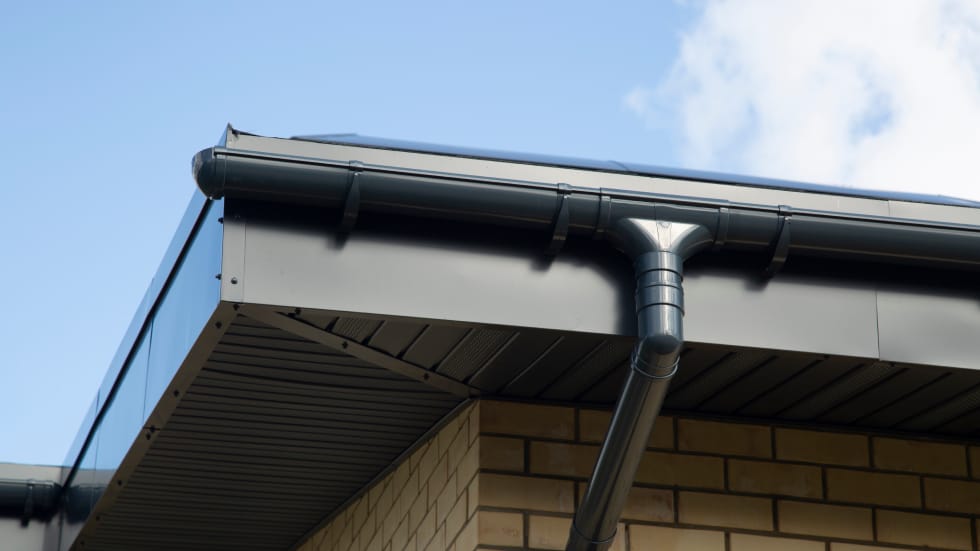
Proper eavestrough slope should drop roughly 1/4 inch for every 10 feet of run, directing water away from your foundation; pooling issues can be eliminated by repositioning hangers or adding downspout extensions.
Fast Facts
- Ideal eavestrough slope: 1/4 inch drop per 10 feet of length
- Water pooling within 6 feet of foundation increases basement leak risk by 60%
- Slope adjustments are needed by most Ontario homes every 5-7 years due to settling
- Downspout extensions should carry water at least 4-6 feet from foundation walls
- Proper slope calculation is typically included in professional eavestrough installation
Understanding Eavestrough Slope Basics
Water flows downhill. Seems obvious, but the specific angle needed by their eavestroughs to work properly isn’t realized by many homeowners. The standard slope drops one-quarter inch for every ten feet of gutter length. Water gets moved toward downspouts by this gentle angle without creating a waterfall effect that splashes back onto your roof or siding.
Over time, hangers are loosened and brackets get shifted. Your perfectly sloped system gradually flattens out. Plus, mini-dams that force water to pool in sections can be created by debris accumulation. This settling process is made to happen faster by Ontario’s freeze-thaw cycles than in warmer climates.
Identifying Water Pooling Problems
Trouble is signaled by standing water in gutters after a rainstorm. But the real issue shows up around your foundation. Wet soil that stays soggy long after rain stops should be looked for. Water stains or that musty smell that develops when moisture gets trapped might be shown by basement walls.
From what we’ve seen, these early warning signs are often missed by landlords during routine property checks. The damage builds slowly; then it suddenly becomes expensive. Water pooling near foundation walls can seep through concrete over months or years, in a way.
Measuring Your Current Slope
The high end of each gutter section should be where you start. A level should be used to check if water would naturally flow toward the downspout. The drop over a ten-foot span should be measured, looking for that quarter-inch difference. Their slope has been lost entirely by most eavestroughs that cause pooling problems, or they even slope backward slightly.
The problem is revealed quickly by a simple string line stretched between the high and low points. If the gutter sits above the string at any point, water will be held by that section. Depending how you look at it, more time is taken by this measurement process than the actual fix in many cases.
Adjusting Hanger Positions
Loose hangers are usually the culprit. The proper slope angle needs to be recreated by repositioning each hanger. Start by loosening the screws slightly; then each hanger should be adjusted to match your target slope line. Work systematically from the high end toward the downspout.
Complete replacement might be needed by some hangers if they’ve pulled away from the fascia board. This happens frequently on older Ontario homes where wood fascia has started to rot or warp. New hangers need to be secured into solid wood, or backing material should be added by the fix.
Extending Downspout Reach
Foundation problems can still be caused by even perfectly sloped eavestroughs if downspouts dump water too close to the house. At least four to six feet away from foundation walls is where water needs to flow. This issue gets solved by extensions, splash blocks, or underground drainage pipes.
The gutters themselves are focused on by many homeowners, but where the water goes afterward gets ignored. A contractor recently told us about a client who spent money on complete eavestrough installation, then wondered why their basement still leaked during heavy rains. Water was being dumped right against the foundation by the downspouts. Funny thing, really.
When to Call Professionals
Minor slope issues can be handled by simple hanger adjustments. But professional eavestrough installation expertise is usually required by sagging fascia boards, damaged gutters, or complex roof lines. The tools and experience to handle these bigger problems safely are possessed by roofing contractors.
Safety matters too. Risks that most homeowners shouldn’t take are created by working on ladders around electrical lines or on steep roofs. Proper insurance and safety equipment are included in professional roofer services. If ongoing foundation water issues are being dealt with by you, expert advice is worth getting to prevent costlier repairs later. Visit our website to learn more about professional eavestrough solutions.
Mini-FAQ
Q: How do I know if my eavestrough slope is wrong? Standing water in gutters after rain should be looked for, or water pooling near your foundation walls. Ice dams in winter are often caused by poor drainage too. That still surprises people.
Q: What tools do I need to check eavestrough slope? A level, measuring tape, and ladder will do the job. Fair point though, caution and experience are required when working on ladders.
Q: Can I adjust the slope myself or do I need a professional? Simple adjustments to hangers can be done by handy homeowners. More complex issues involving fascia damage or complete reinstallation are usually handled by roofing contractors.
Q: How often should eavestrough slope be checked? Funny enough, most people never check until problems are seen by them. Twice yearly inspections help catch issues early.