
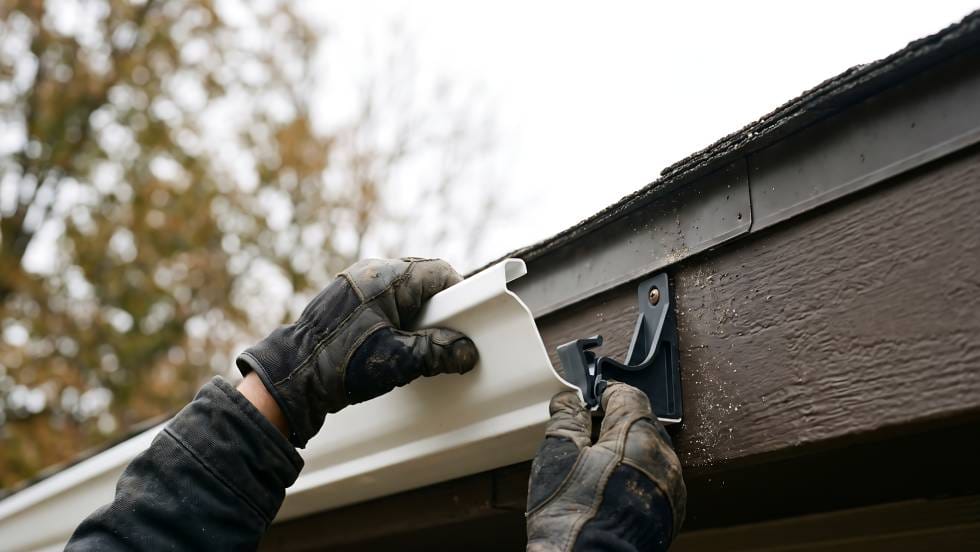
Better long-term performance is usually offered by seamless eavestroughs due to fewer leak points and reduced maintenance needs; however, sectional systems can work well with proper installation and regular upkeep. Budget and maintenance preferences often determine the choice.
Fast Facts:
- 90% fewer joints are found in seamless eavestroughs compared to sectional systems
- Roughly 30-40% less upfront cost is required for sectional systems
- 20-25 years is how long most seamless installations last with minimal maintenance
- Eavestrough joints are particularly stressed by Ontario’s freeze-thaw cycles
- Performance is affected more by professional installation than system type
Understanding the Basic Differences
How these systems are constructed is where the fundamental difference lies. Continuous aluminum coils are formed into seamless eavestroughs right at your property; long runs without joints are created this way. Pre-manufactured pieces are used by sectional systems and get connected together during installation. Both approaches have been used successfully across Ontario for decades.
The installation process affects performance as much as the system type itself, though most homeowners don’t realize this. Well-installed sectional eavestroughs can outlast a poorly installed seamless system.
Joint Performance and Leak Prevention
The weakest points in any eavestrough system are represented by joints. These connection points are where water naturally finds its way, especially during heavy rainfall or snowmelt. Most joints are eliminated by seamless systems except at corners and downspouts; potential leak locations get dramatically reduced this way.
Sealants and mechanical connections are relied upon by sectional systems at every joint. These connections can loosen or degrade over time. However, quality sectional installations with proper sealants often perform well for many years; extreme weather events are when the key difference shows up.
Maintenance Requirements Over Time
Less hands-on maintenance is typically needed by seamless systems. Gutters will still need cleaning and clogs should be checked for, but joint inspection becomes minimal. Proper drainage and corner connections are what most maintenance focuses on.
More attention to joint integrity is required by sectional eavestroughs. Sealant condition should be checked and loose connections tightened during annual inspections. This approach is actually preferred by some Ontario homeowners because individual sections can be replaced without the entire system being affected. Between convenience and control, I suppose it’s a trade-off.
Cost Considerations and Value
Sectional systems are significantly favored by initial installation costs. Less is spent on materials, and less time is typically taken for installation. For budget-conscious homeowners, functional drainage is provided by sectional eavestroughs at a lower entry point.
More is cost upfront by seamless systems but better long-term value is often provided through reduced maintenance and longer service life. When potential repair costs and replacement frequency are factored in, the total cost difference narrows considerably over a 15-20 year period.
Climate Impact in Ontario
Specific challenges for eavestrough systems are created by Ontario’s weather patterns. Materials are caused to expand and contract repeatedly by our freeze-thaw cycles, which stresses joints and connections. Additional strain is also put on the entire system by ice dam formation.
Thermal movement is handled more gracefully by seamless eavestroughs because fewer connection points exist to fail. Problems at joints can be developed by sectional systems during extreme temperature swings. That said, both types work effectively when proper sizing and installation are done for local conditions. Interesting how that works.
Making the Right Choice for Your Property
Your specific situation and priorities are what the best choice depends on. If long-term residence in your home is planned and minimal maintenance is preferred, seamless eavestroughs usually make sense. Many years of reliable performance is what the higher upfront cost gets spread over.
For rental properties or shorter-term ownership, adequate performance is often provided by sectional systems at a lower initial investment. The repairability of sectional systems when tenant-related damage occurs is actually preferred by some landlords. Either way, the biggest difference in long-term performance is made by professional installation. Visit our website to discuss which option works best for your Ontario property.
Mini-FAQ:
Q: Do seamless eavestroughs really last longer? In most cases, yes. Fewer potential failure points are created when there are fewer joints. That said, even the best seamless system can be ruined by poor installation.
Q: What’s the main advantage of sectional eavestroughs? Cost and flexibility. Individual replacement is possible when sections get damaged. Plus, transport and storage are easier.
Q: How much more maintenance do sectional systems need? Look, installation quality and your local weather are what it depends on. Generally speaking, joint inspections will be needed more often and sealant touch-ups might be required every few years.
Q: Are there performance differences in Ontario winters? Any eavestrough system gets tested hard by our freeze-thaw cycles. Thermal expansion is handled better by seamless systems, but both types work when proper installation is done.